


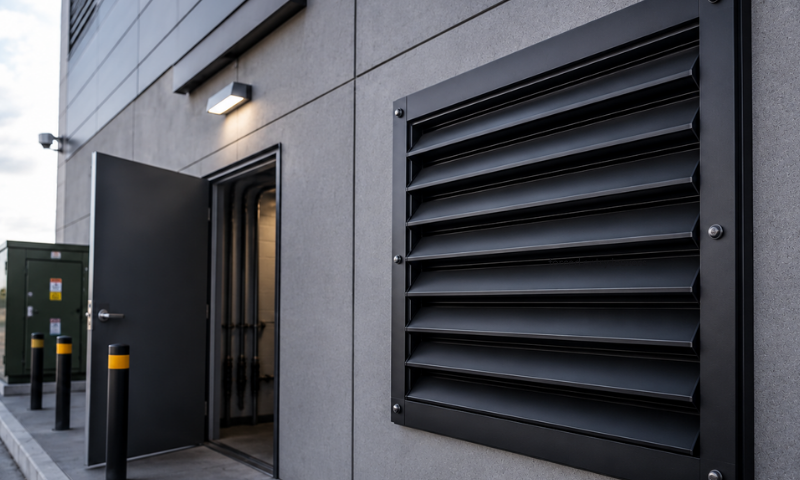
In many protected facilities, most of the planning effort goes into the spaces everyone notices first. Teams focus on front entrances, reception zones, glazing, access control points and visible barriers because these areas shape first impressions and usually carry the highest foot traffic. At the same time, every active site also has another side that receives far less attention during planning: service corridors, maintenance yards, plant rooms, utility walls, loading areas and technical openings that support the daily life of the building. These areas are essential for operation, but they are often designed mainly around airflow, maintenance access and equipment performance. That approach is practical, but it can leave behind a serious vulnerability if the same areas are not reviewed from a security perspective. This is where forced entry louvers become highly relevant. They are designed for openings that must remain functional while also resisting deliberate physical intrusion.
Why do service areas create a different kind of security risk?
Service areas create a different risk because they are built for movement, access and technical support. Maintenance teams need to reach systems quickly, equipment needs ventilation, and service contractors need spaces that are easy to use. In many projects, these practical needs shape the design long before the security team takes a close look at the back-of-house envelope. As a result, side openings, utility vents and technical louvers may end up in quieter areas with less visibility and less supervision than the front of the building. The problem appears when those openings remain at a low level of resistance even after the threat profile of the site becomes clearer. An intruder will not always choose the main entrance. In many cases, the easier path is through a side opening, a technical zone or an area where activity is limited and response time is slower. That is the practical value of forced entry louvers. They help strengthen these necessary openings without removing their role in ventilation or service access.
Which sites are most exposed through back-of-house openings?
This issue matters most in facilities where technical rooms support safety, continuity or essential systems. Hospitals, data centers, transport facilities, utility sites, industrial plants, government buildings and communication hubs all rely on rooms that must keep working under pressure. Generator rooms, electrical rooms, plant spaces, server rooms and communications areas often sit behind external ventilation openings that are easy to overlook during design reviews. Yet these are exactly the kinds of spaces that can affect the performance of the entire site if they are compromised. In many buildings, the public-facing side feels secure because the doors, windows and visible barriers are treated seriously, while the service side remains more exposed. Some openings face loading zones, fenced yards or narrow side passages where an attacker may have more time and less chance of being seen. In these cases, forced entry louvers are part of a realistic answer to an operational problem: how to protect sensitive technical spaces while still allowing them to function every day.
How do forced entry louvers support operation and security together?
One of the biggest concerns in active facilities is whether stronger protection will make the site harder to operate. This is a fair concern because service openings exist for a reason. Ventilation must continue, maintenance teams need access, and technical spaces cannot be treated like sealed vaults. The value of forced entry louvers is that they are made for this exact tension. They help secure an opening without turning it into a dead zone that no longer supports the systems behind it. In the right application, they preserve airflow, support routine operation and add a level of intrusion resistance that standard products do not provide. Active sites need security and usability at the same time. A building cannot rely on a solution that protects well but creates daily frustration for the people who run it. It also cannot rely on a solution that keeps daily work simple while leaving a quiet access point exposed. Forced entry louvers help close that gap by offering a more balanced response.
Where should decision-makers focus before a gap becomes a problem?
The most effective time to address service-side vulnerability is before it turns into a late-stage design issue, a rushed upgrade or an incident that exposes the weakness. Decision-makers should start with a simple review of which technical rooms are critical and which openings connect directly to them. From there, they should look at exposure. Some openings are located in quiet side areas, some are hidden from regular view, and some serve rooms that would create immediate operational trouble if they were compromised. Once that picture is clear, the site team can make more accurate choices about where extra protection is justified and where standard solutions remain enough. This is also the point where specialist guidance becomes valuable. Instead of treating every opening the same way, the team can identify where forced entry louvers actually add security value and where they fit best within the wider building envelope.
Summary
Service areas are often treated as practical spaces first and security spaces second, yet they can carry some of the most important vulnerabilities in an active facility. They support ventilation, maintenance and technical access, but they also create quiet entry points that may be less visible and less protected than the front of the building. In facilities that depend on generators, plant systems, communications or control rooms, this is a serious issue. The goal is to bring their level of protection closer to the importance of the spaces behind them. Forced entry louvers help solve that problem because they strengthen necessary openings while respecting the operational needs of the site.
G.G. Defense Systems
At G.G. Defense Systems, we understand that strong protection must cover the parts of a building that people do not always notice first. We work with clients on facilities where technical rooms, service areas and operational continuity matter every day, and where security gaps in hidden openings can create unnecessary exposure. Our solutions, including forced entry louvers, are designed for projects that need airflow, serviceability and physical resistance to work together as one system. If you are responsible for an active site and want to make sure that service-side openings support the same security standards as the rest of the building, this is the right moment to review them properly. Contact G.G. Defense Systems today and let us help you strengthen the openings that matter most to the performance, continuity and protection of your facility.