


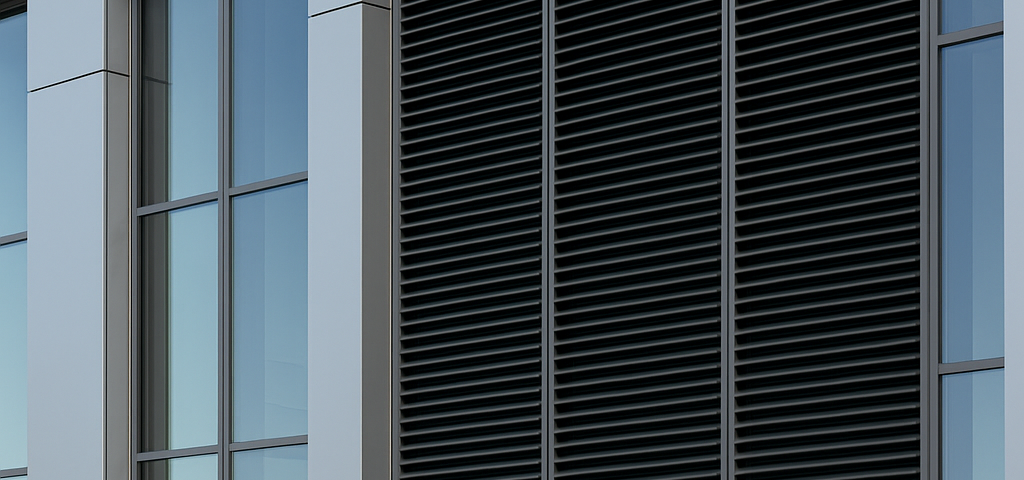
In modern security design, one of the most underestimated challenges is balancing protection with comfort. People want to feel safe inside a building, but they also need fresh air, controlled temperature, and a pleasant environment where it is possible to work, heal, study, or live. This is where blast resistant louvers offer a unique advantage. Instead of choosing between sealed, heavy fortification and open, breathable architecture, planners can integrate systems that quietly do both. They allow critical airflow while helping to protect people and infrastructure from the dangerous effects of explosions, debris, and overpressure.
How do blast resistant louvers actually work?
At first glance, these louvers do not look very different from regular architectural louvers. They are usually slim, horizontal or vertical blades arranged in a frame, allowing air to pass while blocking rain and direct sun. The difference lies in the engineering behind the profile, the internal structure, and the way each blade is connected to the frame. When an explosion happens nearby, a powerful shockwave of pressure and debris travels through the air. Standard louvers may bend, break, or even be torn from the opening, turning themselves into secondary projectiles. In contrast, blast resistant louvers are designed to absorb and redirect part of that energy, keeping the assembly in place and limiting what passes through. Carefully calculated blade geometry, high-strength materials, and tested anchoring systems all work together to manage pressure peaks in a fraction of a second. The goal is not to stop the blast entirely, but to reduce its impact on the interior so that damage and injury are minimized.
Why is airflow so important in secure buildings?
Security is never the only requirement in a real project. Buildings that rely on sealed shells with minimal ventilation quickly become uncomfortable and, in some cases, unsafe for daily use. Heat builds up, humidity rises, and indoor air quality drops, especially in spaces with equipment, crowds, or long operating hours. Traditionally, the solution has been to rely entirely on mechanical HVAC systems and to reduce natural airflow as much as possible. This approach is energy-intensive and vulnerable: if power fails or systems are damaged, the building can become difficult to occupy. By integrating blast resistant louvers in the envelope, designers can create controlled openings that let air move while still respecting the threat environment. In mission-critical facilities, this can support pressure management, smoke control, and heat removal, all while maintaining a defined level of blast performance. The result is a building that feels more natural to occupy, with less dependence on fully sealed, artificial environments.
Where do blast resistant louvers make the biggest difference?
These systems are particularly valuable in facilities where both airflow and protection are essential. Typical examples include energy and utility plants, transportation hubs, defense and government buildings, data centers, and chemical or industrial sites. In these locations, equipment rooms need constant cooling, exhaust, or fresh air intake, yet openings in the façade cannot become weak points in the security strategy. Installing blast resistant louvers in air intakes, mechanical rooms, and protected corridors allows air to circulate without leaving the building exposed to direct blast waves. Even in commercial or civic architecture, they can be part of a layered approach: other elements such as bollards, stand-off distances, and reinforced glazing handle some aspects of the threat, while the louvers protect key service openings. Because they are available in different performance levels, engineers can choose models that match realistic risk scenarios instead of over- or under-designing every opening.
How do these louvers support energy efficiency and comfort?
While the primary role of these systems is protection, they can also contribute to a more efficient building. Allowing controlled natural airflow can reduce the load on mechanical cooling, especially in shoulder seasons and mild climates. In combination with smart controls, blast resistant louvers can open or modulate to respond to temperature, pressure, or air quality sensors. This makes it possible to keep equipment rooms and occupied areas within a comfortable range without running heavy HVAC equipment at all times. Properly oriented louvers can also limit direct solar gain, reduce glare, and help protect sensitive equipment from driving rain. For occupants, this translates into more stable temperatures, cleaner air, and fewer drafts. For owners, it often means reduced operating costs over the life of the building. When the same component provides both resilience and efficiency, the value of the investment becomes clear.
Can blast resistant louvers be integrated into modern architecture?
One of the most common concerns from architects is that security features will ruin the look of a façade. Older generations of protective systems were bulky, industrial, and visibly “military” in appearance. Today, blast resistant louvers can be designed with slim profiles, custom colors, and coordinated module sizes, so that they blend seamlessly into curtain walls, screened façades, or ventilated cladding. They can be hidden behind decorative grilles, combined with sunshading systems, or expressed as a deliberate design feature with rhythm and depth. The key is early coordination: when security consultants, mechanical engineers, and architects work together from the start, it becomes much easier to align performance, airflow, and appearance. This allows projects to meet strict safety criteria without sacrificing the identity of the building or the comfort of its users.
G.G.Defernse Systems
In any security-sensitive facility, every opening is a decision point. Choosing to ignore airflow in the name of protection creates spaces that are hard to inhabit and expensive to operate. Ignoring blast risk in order to prioritize natural ventilation creates exposures that can be catastrophic in a single event. The real progress comes from solutions that acknowledge both sides of the equation. Properly selected and engineered, blast resistant louvers help bridge this gap. They allow buildings to breathe while helping to shield occupants, equipment, and critical infrastructure from dangerous blast effects. For owners, planners, and operators who are serious about resilience, these systems represent a quiet but powerful upgrade. Partnering with an experienced manufacturer and integrator, such as G.G. Defense Systems, ensures that performance claims are backed by testing, documentation, and real-world expertise. If you are planning a new facility or reviewing an existing one, this is the moment to look again at every vent, grille, and opening, and ask whether it is doing enough. With thoughtful design and the right technology in place, you can achieve both safety and comfort without compromise.