


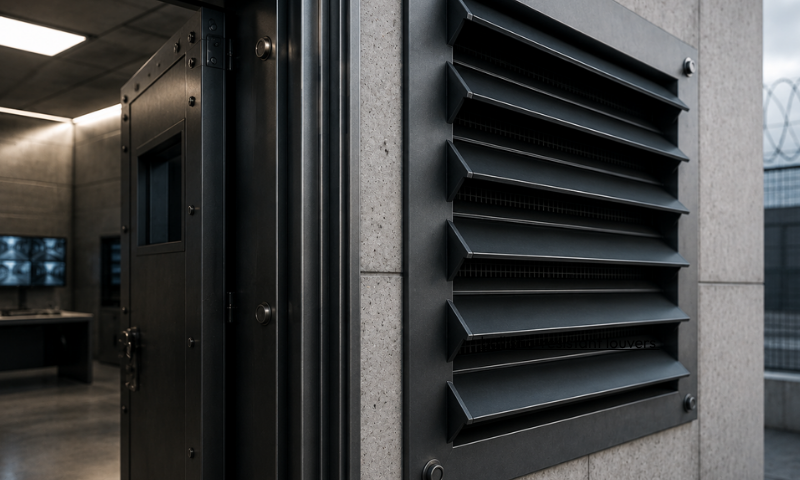
In high-risk buildings, people usually focus first on the visible layers of protection. They think about reinforced doors, strong walls, protected windows, access control and surveillance. All of these are important, but in many projects there is one detail that gets less attention than it deserves: the ventilation opening. The room itself may look secure, the equipment inside may be critical, and the overall site may follow strict security rules, yet one unprotected opening can still create a serious weakness. This problem appears in many types of facilities, especially where technical rooms need constant airflow to keep systems working properly. That is where ballistic-resistant louvers become relevant. They are designed for situations where a room must stay ventilated while still meeting a higher level of protection. For many decision-makers, this is not just a product question. It is a risk question. If the room behind the opening matters, then the opening itself matters too.
Why can a protected room still have one major weak point?
A room can be secure in almost every visible way and still remain exposed through a single overlooked element. This happens because ventilation is often treated as a technical requirement, while protection is treated as a separate security issue. In reality, the two are deeply connected. A generator room, control room or data room cannot function without air movement, so openings are built into the structure to support cooling and ventilation. Standard louvers are useful for weather protection and airflow, but they are not built to stop bullets or resist a determined attack. That creates a gap between the strength of the room and the weakness of the opening. In a real incident, attackers do not always choose the strongest or most obvious point on a building. They look for the place that gives them access with the least resistance. If the room behind the opening contains systems that support power, communications or operations, the consequences can go far beyond physical damage to a single wall. This is exactly why many high-risk facilities start looking at ballistic-resistant louvers as part of the wider protection strategy. The issue is not just whether the room is secure on paper. The issue is whether every important part of its envelope is strong enough for the threats the site may actually face.
Which facilities are most exposed through ventilation openings?
Some buildings can safely rely on standard ventilation products, but others carry a level of risk that calls for a more serious approach. Facilities with generator rooms are a common example, because emergency power systems are essential when other systems fail. If a generator room is damaged during an attack, the entire site may lose a critical layer of resilience at the exact moment it is needed most. Data centers and server rooms are another clear example, because they depend on temperature control and cannot simply be sealed off. Control rooms in transportation, utilities, communications and energy sites also fall into this category, since even a short disruption can affect operations on a wider scale. Government buildings, embassies, defense-related facilities and sensitive industrial sites often include technical spaces close to the facade, and those spaces may rely on louvered openings that are visible and reachable from outside. In all these environments, ballistic-resistant louvers help close a gap that standard products cannot address. They allow airflow to continue while improving the ability of the building to resist hostile actions aimed at critical internal systems. For project teams, the question is not whether every opening needs this level of protection. The real question is which openings serve rooms that are too important to leave vulnerable.
Why do ballistic-resistant louvers matter for continuity and not only for security?
When people hear the word ballistic, they often think only about stopping bullets. That is part of the story, but it is not the whole story. In many real projects, the bigger concern is continuity. A facility may survive a security event structurally and still suffer major operational damage if one essential room is disabled. If a control room stops functioning, the site may lose coordination. If a generator room is compromised, backup systems may fail. If a communications room goes offline, response time and decision-making may be affected. In that sense, ballistic-resistant louvers support continuity by protecting the rooms that keep the wider facility working. They help reduce the chance that a vulnerable opening will become the reason an entire operation slows down, shuts down or enters crisis mode. This is especially important in sites where even a few hours of disruption can lead to financial losses, service failures or public safety concerns. For building owners and managers, that makes the conversation easier to understand. The decision is not only about adding another layer of defense. It is also about protecting uptime, reducing avoidable downtime and supporting the long-term reliability of the site. Once this wider operational view is clear, the value of ballistic-resistant louvers becomes much easier to explain to stakeholders who may not come from a security background.
How can the right solution strengthen both airflow and protection?
A good protective solution should never solve one problem by creating another. That is especially true in rooms that depend on ventilation. Blocking air movement can lead to overheating, equipment stress and long-term reliability issues, which means the design must respect both security and engineering needs. This is where specialist planning becomes essential. The right solution begins with understanding the room behind the opening, the level of threat the site faces, and the performance the opening must deliver. In some projects, the answer may involve different levels of protection in different parts of the building. In others, the facility may need a more comprehensive concept that combines ventilation protection with doors, windows and other hardened elements. What matters most is that the protection level is matched to the real risk and to the real use of the room. Ballistic-resistant louvers are valuable because they support this balance. They help preserve airflow while strengthening the external envelope in places where standard products are no longer enough. When selected and integrated properly, they allow a facility to remain functional, maintain its technical performance and improve its physical resilience at the same time. That balance is what turns a product choice into a real security solution.
In many projects, the best decisions come from looking at the whole picture instead of focusing only on one product line. A ventilation opening may seem like a small technical detail until it is viewed in the context of what lies behind it. Once that happens, it becomes clear that some openings deserve much more attention than they usually receive. Ballistic-resistant louvers are not needed everywhere, but in the right setting they can play a major role in protecting the rooms that matter most. They help close a vulnerability that often stays hidden until a risk assessment becomes more serious or until project teams start asking the right questions about continuity, exposure and building performance.
G.G. Defense Systems
At G.G Defense Systems, we work with clients who need practical protection for real buildings with real operational demands. We understand that secure facilities must keep working, not just look protected on drawings. Our team designs, manufactures and delivers advanced solutions, including ballistic-resistant louvers, for sites where critical rooms depend on airflow and cannot afford weak points in the envelope. If you are planning a project or reviewing an existing facility and you want to understand whether your ventilation openings support the level of protection your site actually needs, this is the right time to act. Contact G.G Defense Systems and let us help you turn one of the most overlooked vulnerabilities in a building into a stronger, smarter part of your security strategy.