


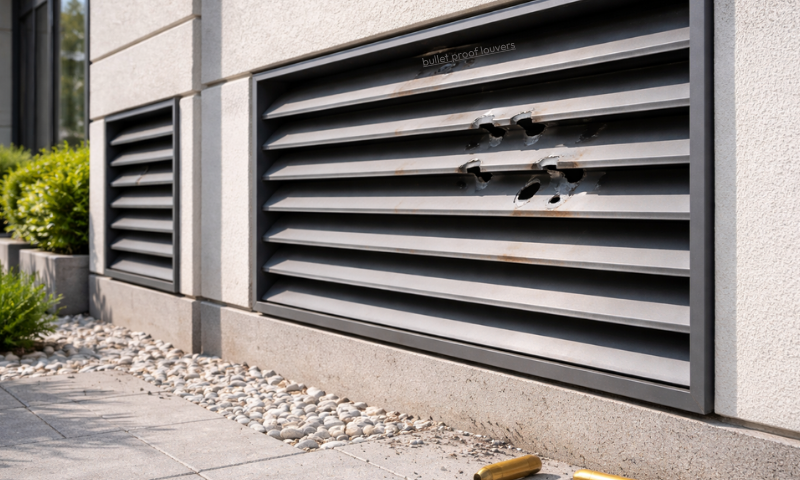
Security upgrades usually focus on doors, windows, and perimeter barriers because they are easy to see and easy to prioritize, but many buildings have a quieter weak point that is just as important: ventilation openings. Mechanical rooms, generator areas, data centers, and other critical spaces depend on airflow to stay operational, so vents and façade louvers are often large, exposed, and located where they can be reached from outside. The problem is that standard ventilation openings are designed for air movement, not protection, and that gap can undermine the value of every other security investment. This is why bullet proof louvers matter in real facilities, not as a luxury feature, but as a practical solution that protects vulnerable openings while keeping systems running as intended.
Why are ventilation openings a security risk?
Ventilation openings can become a security risk because they are often the least protected part of the building envelope while still providing a direct path toward critical equipment and internal spaces. Even when a facility has reinforced doors and ballistic windows, a standard louver may remain thin, lightly framed, and mounted with hardware that was never meant to resist ballistic impact. That creates a situation where an attacker does not need to challenge the strongest point; they can target the weakest point and still cause serious harm, either by firing through the opening toward people or equipment, or by damaging mechanical systems that keep the site functional. In environments where uptime is essential, such as communications hubs, industrial plants, or secure campuses, a single vulnerable ventilation opening can lead to operational shutdown, safety risks for staff, and expensive recovery, which is why ventilation security should be part of any complete protective plan.
What are bullet proof louvers and how do they work?
Bullet proof louvers are ventilation systems engineered to allow airflow while providing ballistic resistance, and although the search term bullet proof louvers is common, the professional concept is bullet resistance based on defined threat levels and test standards. These louvers are built so that airflow can pass while direct lines of fire are blocked by angled blades and reinforced internal construction, and the system is designed as a complete assembly rather than a simple metal grille. Instead of thin blades and light frames, the blades, frame, and anchoring are designed to manage impact, reduce penetration, and limit dangerous fragmentation, so the opening remains a controlled point in the façade rather than an exposed gap. The practical value is clear: you keep ventilation for critical rooms while reducing the risk that the opening becomes a path for ballistic attack or damage to essential infrastructure.
How do you balance protection with airflow and performance?
The main reason organizations hesitate to upgrade vents is the concern that adding protection will reduce airflow and create overheating or system strain, but the correct solution is not to choose between safety and performance; it is to specify a system that is designed to deliver both. Bullet proof louvers should be selected with clear operational requirements in mind, including the airflow needed for the space, the acceptable pressure drop, the available opening size, and the maintenance expectations, because mechanical performance is part of mission continuity. A well-planned louver solution can maintain ventilation targets while improving security, especially when the design considers blade geometry, free area, framing depth, and installation constraints from the start. When protection and airflow are treated as one requirement, not two separate goals, facilities avoid common failures such as reduced cooling capacity, noisy airflow, frequent service issues, or a protective product that looks good on paper but does not fit the real operating conditions.
How do you choose the right solution for your site?
Choosing the right solution starts with understanding what you are protecting, where the ventilation opening is located, and what threat level is realistic for the site, because different environments require different performance targets. A public-facing facility may prioritize protection for areas near entrances and ground-level openings, while an industrial site may focus on generator rooms, control rooms, and equipment zones that must remain stable during an incident. It is also important to align the louver with the rest of the security envelope so that doors, windows, and ventilation openings deliver a consistent level of protection rather than leaving one element behind. This is where bullet proof louvers provide clear value: they let you remove a common weak point without redesigning the entire building, and they support a complete approach where every opening is considered part of the same protection plan.
What should readers remember about ventilation security?
Ventilation openings are essential for operations, but they can become a major security gap when they are treated as purely mechanical features rather than part of the building’s protective envelope. The most effective approach is to identify exposed vents near critical rooms and public areas, set clear requirements for both airflow and protection, and select systems designed to meet both needs without creating operational problems. When ventilation is secured correctly, the building becomes more consistent in its protection, equipment is less exposed, and continuity improves, which is exactly the goal of a serious security investment. For many facilities, bullet proof louvers are the missing piece that turns partial security into complete security by addressing a vulnerability that is often overlooked.
Who can help you implement the right solution?
G.G. Security Systems supports organizations that need protection without compromising daily performance, and we understand that ventilation security must work in real operating conditions, not just in theory. If you are reviewing risks at a facility with exposed vents, mechanical louvers, generator openings, or critical rooms near exterior walls, our team can help you evaluate the site and recommend bullet proof louvers that match both your protection goals and airflow requirements. Contact G.G. Security Systems to discuss your project, define priorities, and move forward with a clear plan that closes weak points while keeping your facility functional and secure.