


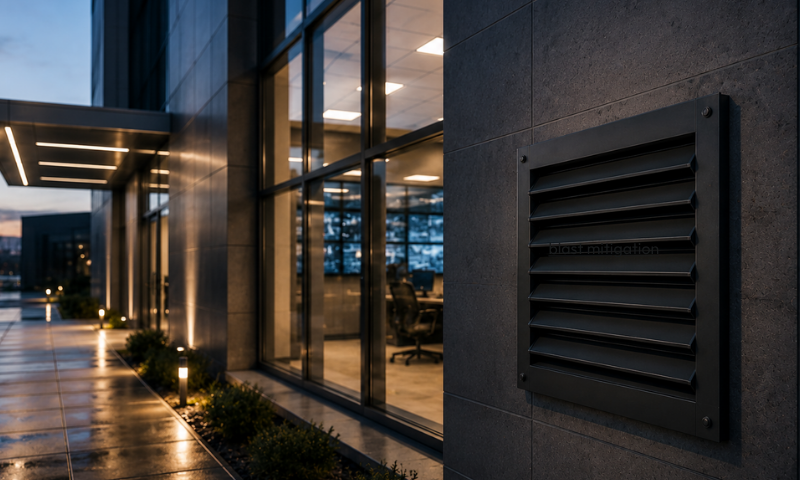
When people hear the term blast mitigation, they often imagine one moment: the blast itself. The pressure wave hits, the building responds, and the story seems to end there. In real projects, that is only the beginning. The true test of protection starts in the seconds and minutes after the event. Can people move safely? Do doors still open? Have windows become dangerous debris? Is the control room still functioning? Can the site be evacuated, stabilized, or brought back online? This is where many owners and project teams discover that effective blast mitigation is not only about resisting force. It is about limiting what happens next, reducing secondary damage, and helping the building remain as safe and functional as possible. That wider view is becoming more important for commercial facilities, public buildings, critical infrastructure, and any site where people, operations, and reputation all matter.
Why do many projects misunderstand the real goal of blast mitigation?
A common mistake is to think of protection only in structural terms. If the building does not collapse, some teams feel the design has done its job. That is too narrow. A building can remain standing and still suffer serious damage that puts people at risk and shuts operations down. Flying glass, damaged doors, failed louvers, unstable wall elements, and blocked circulation routes can all create dangerous conditions even when the main structure survives. This is why strong blast mitigation strategies are judged by more than structural survival. They are judged by how well they control fragmentation, reduce internal hazards, protect critical spaces, and preserve enough function for emergency response and recovery. G.G’s own blast-related content already emphasizes that blast protection involves systems and materials across windows, doors, façades, louvers, and supporting building elements, not just one reinforced component.
What kinds of damage continue after the pressure wave is over?
Once the initial wave passes, a second layer of problems often appears. Windows may break inward, sending fragments into occupied areas. Doors may deform or jam, which affects escape routes and emergency access. Louvers and façade elements may fail and expose technical spaces behind them. Internal partitions can be damaged, ceilings can loosen, and important equipment may stop working because the room around it has been compromised. In sites that depend on backup power, communications, or control systems, these secondary effects can be just as serious as the blast itself. A facility may not be destroyed, yet it may still lose the ability to support people or continue operating. That is why blast mitigation must be understood as a way to reduce the chain reaction that follows an explosive event. The goal is to lower injury risk, preserve access, and prevent one incident from turning into a longer operational crisis. G.G’s pages on blast mitigation, commonly used solutions, and blast-resistant materials all point to this layered approach, where multiple building elements work together to reduce harm and keep systems protected.
How does blast mitigation protect continuity and not only structure?
For many clients, the most important question is not only whether the building can absorb a blast, but whether the site can still function afterward. Hospitals, airports, embassies, utility sites, data-related facilities, and commercial buildings all face some version of this concern. If the envelope is damaged in a way that stops operations, blocks access, or forces long repairs, the financial and operational impact can be enormous. In that sense, blast mitigation is also a continuity tool. It helps reduce downtime, supports emergency procedures, and protects the spaces that keep the wider site working. This can include keeping safe rooms usable, protecting control areas, maintaining access to exits, and reducing the chance that damaged components will disable rooms that were not directly hit. Some of G.G’s recent blast content also frames protection in terms of resilient design and future readiness, which supports this broader understanding: the purpose is not only to survive an event, but to remain usable, manageable, and safer afterward.
Why does a complete blast mitigation strategy need more than one product?
No single product can solve every blast-related risk in a building. A complete response usually requires several elements working together. Windows may need to control fragmentation. Doors may need to remain functional under pressure. Louvers may need to protect technical rooms without blocking airflow. Walls or interior fabrics may help reduce secondary hazards and improve the behavior of specific spaces during an event. Anchoring, detailing, and integration matter just as much as the products themselves, because weak connections can undermine strong materials. This is why blast mitigation should be planned as a coordinated system rather than a shopping list of protective items. G.G’s site reflects this clearly through its range of blast-related solutions, from windows and materials to fabrics and retrofit systems, all aimed at helping buildings behave better under real stress. For owners and project managers, this means the right question is not Which single product should I buy, but How should the protective layers of this building work together to reduce damage and support recovery.
What should decision-makers focus on before choosing a blast mitigation approach?
The starting point should be the actual role of the building and the consequences of disruption. A facility that houses sensitive operations, critical equipment, or large numbers of occupants should be evaluated differently from a lower-risk site. Decision-makers should look at where people gather, which rooms are essential to operations, how façades and openings behave, and what level of damage the organization can realistically tolerate. They should also think about what needs to remain usable immediately after an event: exits, command spaces, utility rooms, communications, and protected routes. This makes the conversation much more practical. Instead of focusing only on peak pressure numbers, teams can connect blast mitigation to people, continuity, and recovery. That kind of discussion usually leads to better choices, because it aligns protective design with the actual mission of the building. G.G. Defense Systems׳s project and solutions pages show a broad portfolio across windows, façades, materials, and tailored force-protection applications, which fits exactly this type of site-specific planning.
In summary, the real value of blast mitigation becomes clear after the initial event, when people need safe movement, systems need to keep working, and owners need the building to remain manageable. A project that focuses only on the blast wave risks missing the wider purpose of protection. Strong planning looks at secondary damage, continuity, access, and recovery, and then uses the right combination of solutions to reduce those risks in a practical way. That is what turns protective design from a technical requirement into a real operational advantage.
G.G Defense Systems
At G.G Defense Systems, we help clients approach blast mitigation as a complete building-performance issue, not as a single product decision. We design and supply tailored solutions for windows, façades, louvers, materials, and retrofit applications in projects where security, function, and resilience all matter. If you are reviewing a high-risk facility or planning a new one, now is the right time to ask a bigger question: not only how the building will face a blast, but how it will protect people and continue operating afterward. Contact G.G Defense Systems to build a more resilient strategy from the start.