


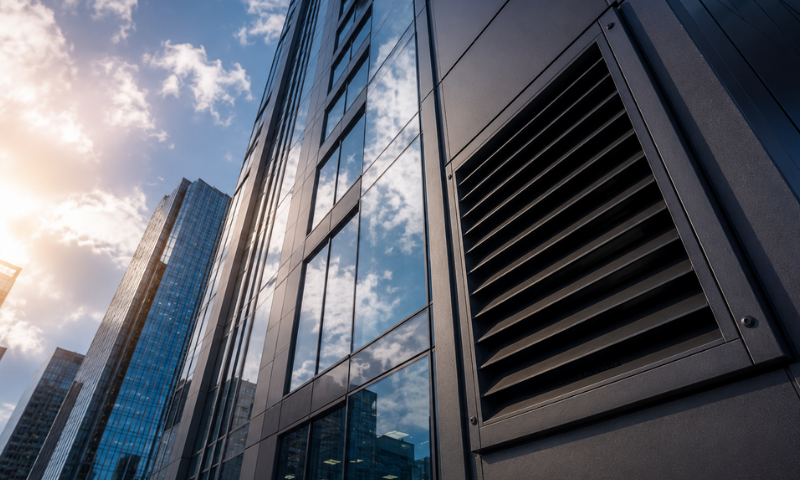
In many high-security projects, the first planning conversations focus on function. The room needs airflow, the equipment needs cooling, the maintenance team needs access, and the building has to keep operating every day without interruption. All of that is reasonable. The problem begins when security questions come later, after many technical decisions have already been made. At that stage, teams suddenly realize that some of the openings designed for ventilation and service access are also possible entry points. What looked like a practical engineering detail becomes a security concern, and solving it late is usually harder and more expensive. This is exactly where forced entry louvers become relevant. They support the wider goal of making sure a building performs under pressure, not only in normal daily conditions, but also when someone tries to break in through the least obvious path.
Why are ventilation decisions often made before security decisions?
In real projects, ventilation and mechanical planning usually start early because they are tied directly to the daily life of the building. Equipment rooms need cooling, generators need airflow, technical spaces need exhaust paths, and engineers want to lock in layouts as soon as possible. Security planning sometimes follows later, especially when the building is not a military site or a highly visible government facility. This creates a gap. By the time security consultants or risk managers review the building envelope, the ventilation openings may already be fixed in size, location and type. At that point, teams discover that a technically correct louver is not always a secure louver. A standard product may support airflow and maintenance well, but it may also create a point where tools, force or repeated impact could lead to unauthorized entry. That is why forced entry louvers matter. They bring intrusion resistance into a part of the building that is often planned first for air and access.
What problems appear when intrusion resistance is added too late?
When forced-entry protection is considered only after the basic mechanical design is complete, several predictable problems appear. The first is cost. Late changes almost always cost more because they affect drawings, procurement and sometimes structural preparation. The second is compromise. When a project is already advanced, teams are more likely to accept a partial solution simply to avoid delay. The third is confusion. The architect may think the issue belongs to the security consultant, the mechanical engineer may think it belongs to the facade team, and the client may assume the original specification already covered it. In that situation, nobody fully owns the problem until it becomes urgent. This is where forced entry louvers often enter the discussion in a reactive way instead of a planned way. Rather than being selected as part of a clear strategy, they are added because the team suddenly realizes an opening is too exposed to leave unprotected. That approach increases the chance of choosing a solution that fits the schedule better than it fits the threat.
Where do forced entry louvers become critical in real projects?
Not every ventilation opening needs the same level of protection, but some areas deserve much closer attention than others. Technical rooms are a major example. Generator rooms, electrical rooms, server spaces, communication hubs and plant areas often contain systems that keep the building running. If an intruder reaches them, the damage can spread far beyond a single room. That is why forced entry louvers become especially important in places where the room behind the opening supports continuity, safety or core operations. The same logic applies to service-side areas that are less visible to the public, where an attacker may have more time to work without being noticed. In some facilities, back-of-house openings face loading zones, fenced utility yards or side passages with low foot traffic. These are the kinds of locations where a building can feel secure from the front while remaining more exposed at the edges. In these cases, the value of forced entry louvers lies in protecting the systems and spaces that the building depends on every day.
How can early planning prevent expensive security gaps?
The best way to avoid late surprises is to treat airflow and intrusion resistance as part of the same conversation from the beginning. That does not mean every opening must become a high-security opening. It means the project team should identify early which rooms are operationally important, which openings are exposed, and where forced-entry risk is high enough to justify a stronger solution. Once that is done, forced entry louvers can be selected in a deliberate way, based on real function and real risk rather than on panic or last-minute adjustment. Early planning also makes coordination easier. The mechanical engineer can confirm airflow needs, the security team can define threat expectations, and the architect can integrate the solution into the building envelope before construction details are frozen. This helps prevent redesign, rushed approvals and uncomfortable compromises. It also helps clients understand why one opening needs more protection than another.
Why does this matter so much for owners and facility managers?
Owners and facility managers are often the people who feel the consequences when planning decisions were not aligned early enough. They inherit the building after the project team moves on, and they are the ones who must operate it, maintain it and respond when something is not working as expected. If security measures were added late without enough thought, daily use may become harder, maintenance may become more complicated, and the building may still carry weaknesses that were never fully resolved. This is why forced entry louvers should be seen as part of long-term building performance, not just short-term project compliance. A secure facility is measured by how well it supports real operations over time, including periods of elevated risk.
In summary, many secure projects run into trouble late because technical planning moves faster than security planning. Ventilation openings are a common example of this disconnect. They are necessary, functional and easy to overlook until someone asks how they will perform during an intrusion attempt. At that point, teams often realize they need to correct a gap that should have been addressed much earlier. Forced entry louvers help solve that problem, and they deliver the most value when they are part of the project from the start.
Why to choose G.G.Defense Systems?
At G.G Defense Systems, we work with clients, consultants and project teams who want to close these gaps before they become expensive problems. We design, manufacture and deliver high-security solutions, including forced entry louvers, for projects where airflow, serviceability and physical protection must work together. If you are planning a sensitive facility or reviewing an existing one and want to make sure that technical openings are not weakening the wider security strategy, this is the right moment to act. Contact G.G Defense Systems and let us help you turn early questions into stronger decisions, safer openings and a more resilient building.